If you're planning to launch a marketplace, one of the first questions you'll ask is: How much will it actually cost to build?
The honest answer is that there is no universal price. A simple platform connecting buyers and sellers is a very different engineering project from a full marketplace with mobile applications, automated payments, logistics, seller management and AI-powered product discovery.
However, the cost isn't as mysterious as it might seem.
Understanding the components of a marketplace, the engineering decisions behind them and the features you actually need can help you estimate a realistic budget before development begins.
At Hamo Engineering, we've experienced these challenges firsthand while building Dokkan, a multivendor marketplace designed for the Tunisian market, connecting buyers, independent sellers, commerce operations and delivery workflows through a shared digital ecosystem.
Here's what you should know before investing in your own marketplace.
The short answer: How much does a marketplace cost?
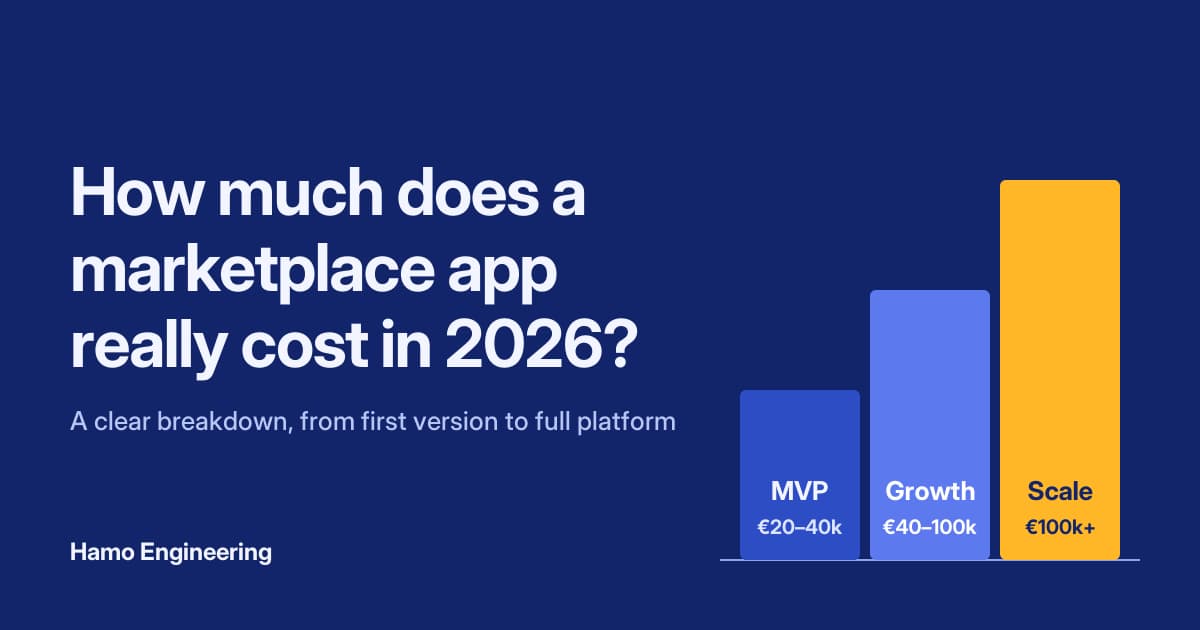
For a custom-built marketplace in 2026, these are useful indicative budget ranges:
Development stage | What you get | Typical timeline | Indicative budget |
|---|---|---|---|
Lean MVP | Buyer and seller accounts, product listings, basic ordering, essential admin tools | 2–4 months | €15,000–€30,000 |
Growth platform | MVP + seller dashboard, mobile applications, payment integrations, shipping workflows, reviews and notifications | 4–8 months | €30,000–€80,000 |
Advanced platform | Advanced search, recommendations, automation, analytics, complex integrations and scalable infrastructure | 8–12+ months | €80,000–€150,000+ |
These figures are planning estimates, not fixed market prices or Hamo Engineering quotations. Actual costs depend on the features, integrations, design requirements, development team and country.
A marketplace developed with a Western European or North American agency may cost considerably more than one developed by an experienced team in Tunisia or another competitive engineering market.
The important distinction is that development location affects hourly rates and project costs, but it doesn't eliminate the engineering work required to build a reliable product.
Why does a marketplace cost more than a regular application?
A traditional online shop usually operates around one main business: a company sells its own products to customers.
A multivendor marketplace introduces an entirely different level of complexity.
At minimum, it involves three interconnected environments:
Buyers: Discover products, compare offers, place orders, make payments and track deliveries.
Sellers: Manage their stores, products, inventory, orders and customer interactions.
Platform administrators: Manage sellers, commissions, transactions, disputes, quality control and marketplace operations.
Depending on the business model, you may also need delivery partners, customer support agents, warehouse operators and additional administrative roles.
Every role has different permissions, workflows and responsibilities. Yet they all need to communicate through the same underlying platform.
For example, when a customer purchases products from two different sellers, the platform may need to split the order, calculate commissions, coordinate separate deliveries, update inventory and provide accurate order tracking.
This is why a marketplace is not simply an online store with multiple seller accounts. It is a connected business system.
If you're considering building one, our eCommerce and Commerce engineering services cover the development of custom storefronts, multivendor marketplaces, seller systems and the infrastructure behind modern commerce platforms.
What really drives marketplace development costs?
Understanding the main cost drivers is more useful than comparing development quotes without knowing what's included.
1. User roles and business workflows
A basic marketplace may only require buyers, sellers and administrators.
But as the business grows, you might introduce:
Delivery partners and couriers.
Customer support teams.
Warehouse operators.
Regional administrators.
Seller managers and moderators.
Each additional role introduces authentication rules, permissions, interfaces and workflows.
The complexity increases further when different users need access to different information or administrative capabilities.
2. Payment processing and seller payouts
Payments are among the most important architectural decisions in marketplace development.
A regular online store receives payments directly. A multivendor marketplace may need to manage transactions involving multiple independent sellers.
Depending on the payment provider and business model, this can involve:
Commission calculations.
Seller balances and transaction records.
Split payments.
Refunds and cancellations.
Payment reconciliation.
Seller payout schedules.
Transaction reporting.
Not every payment provider supports automated marketplace payouts. Some business models require additional financial workflows or manual reconciliation.
This is particularly important when launching in markets where local payment methods differ from those commonly used in Europe or North America.
3. Shipping and logistics integrations
Logistics can become one of the most underestimated parts of a marketplace.
If sellers handle their own deliveries, the platform still needs to manage shipping information, delivery statuses and customer notifications.
A more advanced system may require:
Multiple shipping providers.
Delivery fee calculations.
Shipment tracking.
Pickup and delivery workflows.
Courier assignment.
Failed delivery management.
Return and exchange processes.
For marketplaces operating across large geographic areas, logistics should be considered an important part of the initial architecture rather than an afterthought.
4. Search and product discovery
A basic product search is relatively straightforward.
However, a marketplace with thousands of products and multiple sellers needs more sophisticated discovery capabilities.
Depending on your audience, you might need:
Filters and category navigation.
Typo-tolerant search.
Multilingual search.
Search suggestions.
Personalized recommendations.
Image-based product discovery.
AI-powered search and product matching.
These capabilities can improve the shopping experience, but they also introduce additional development, infrastructure and maintenance requirements.
Explore our AI integration and intelligent automation services to understand how AI capabilities can become part of production software rather than isolated experiments.
5. Web platform or mobile applications?
A marketplace can start as a responsive web application, a mobile application or both.
A web-first approach is often sufficient for validating the business model.
Mobile applications become increasingly valuable when customers regularly interact with the marketplace, receive notifications, track deliveries or communicate with sellers.
Cross-platform development using technologies such as React Native allows a shared application codebase to serve both iOS and Android.
This can reduce duplicated development work compared with maintaining two entirely separate native applications.
At Hamo Engineering, we use modern mobile development technologies to build connected mobile experiences. You can explore our web and mobile application development services.
6. Seller dashboard and administration
The customer-facing application is only one part of the marketplace.
Sellers need a practical environment to manage their business, including:
Product and inventory management.
Order processing.
Sales history.
Store configuration.
Customer communication.
Performance information.
Administrators need a different set of tools to monitor the entire ecosystem, manage sellers, configure commissions, investigate disputes and oversee operations.
A poorly designed back office creates unnecessary manual work and becomes increasingly expensive as the number of sellers grows.
7. Architecture, security and infrastructure
A marketplace handles sensitive information, user accounts, transactions and business data.
Its architecture must account for:
Authentication and authorization.
Secure API communication.
Database design and data consistency.
Protection against common application vulnerabilities.
Backups and recovery.
Monitoring and error tracking.
Performance under increasing traffic.
Automated testing and deployment.
These engineering activities are not always visible in the final interface, but they have a direct impact on the long-term reliability and maintenance cost of the product.
Our Cloud and DevOps infrastructure services explain how we approach deployment, server management, security, monitoring and infrastructure reliability.
8. Languages and local market requirements
A marketplace targeting multiple countries or language communities needs more than translated interface labels.
You may need:
Multilingual product information.
Right-to-left interface support.
Local payment integrations.
Different delivery providers.
Country-specific tax and business rules.
Localized notifications and customer communication.
These requirements should influence the architecture from the beginning, particularly when international expansion is part of the long-term business plan.
The costs nobody puts in the initial development quote
Building the platform is only the beginning.
A marketplace also requires ongoing operational investment.
Here are some expenses worth considering before launch.
Hosting and infrastructure
Servers, databases, image storage, backups and monitoring all contribute to your monthly operating costs. Infrastructure should match your actual traffic and technical requirements rather than starting with unnecessarily expensive enterprise services.
Maintenance and updates
Software needs ongoing attention. Security updates, dependency upgrades, bug fixes, compatibility changes and performance improvements are part of running a production platform.
A common initial planning allowance is around 15–20% of the original development budget annually for maintenance, although actual costs depend on the scope of the maintenance agreement and the pace of product development.
Payment processing fees
Payment providers typically charge transaction-based fees. Depending on your business model, these can have a direct impact on marketplace profitability.
App store accounts
Publishing mobile applications requires developer accounts and compliance with Apple and Google requirements. Account fees and applicable program conditions should be checked before launch.
Marketing and seller acquisition
A marketplace without sellers has little value to buyers. Likewise, sellers need customers to generate transactions.
Seller onboarding, advertising, promotional campaigns and customer acquisition should have their own budgets.
Customer support and daily operations
Someone needs to handle account problems, refunds, disputes, seller questions and delivery issues.
These operational responsibilities often become more demanding as transaction volume increases.
What we learned building Dokkan
One of the best ways to understand marketplace complexity is to look at an actual product rather than theoretical feature lists.
Dokkan is a multivendor marketplace engineered around the realities of the Tunisian market.
It connects buyers, independent sellers, commerce operations and delivery workflows within one digital ecosystem.
The platform brings together several important components:
1. A shared commerce foundation
Products, sellers, buyers, orders and inventory need to remain synchronized across different interfaces.
We approached this as a connected commerce platform rather than a collection of independent applications.
2. Dedicated seller operations
Sellers need practical tools to manage their products, stores, inventory and orders without relying on administrators for every operation.
3. Logistics as a core component
Delivery is not simply a final status attached to an order. It requires workflows that connect orders, delivery partners, shipment states and customer visibility.
4. Mobile experiences
Dokkan also has a dedicated mobile experience built with React Native and Expo, supporting marketplace discovery, shopping, orders, notifications and delivery tracking across iOS and Android.
5. AI-powered capabilities
AI introduces additional possibilities for product discovery, translation, content and interactions adapted to local users.
However, these capabilities should solve actual business problems rather than exist simply because AI is popular.
You can explore the Dokkan engineering case study to see how these components fit together.
How to reduce marketplace development costs without sacrificing quality
Reducing the initial budget doesn't necessarily mean choosing inferior technologies or compromising on engineering standards.
It means making better decisions about what should be built now and what can wait.
Start with one category or market
Instead of launching a marketplace for every possible product and audience, start with a focused segment.
A marketplace dedicated to a specific product category or geographic area is easier to validate and operate.
Build the essential workflows first
Your first version should support the fundamental marketplace cycle:
A seller registers and publishes products.
A buyer discovers and orders a product.
The platform processes the order.
The seller prepares the order.
The delivery is completed.
The platform records the transaction.
Everything else should be evaluated according to its importance to this core workflow.
Automate progressively
You don't need to automate every administrative task on day one.
For an early marketplace, some activities can be handled manually, provided the process is secure, documented and manageable.
For example, manual seller verification or periodic payout reconciliation may be reasonable during an initial validation phase.
However, core data integrity, access control and transaction records should never be treated as optional.
Choose an architecture that can evolve
Starting small doesn't mean building something disposable.
A modular, maintainable architecture allows you to introduce additional capabilities without unnecessarily rebuilding the entire product.
This is especially important for marketplaces because new requirements often emerge after the first real transactions.
Work in clearly defined development phases
A well-defined scope protects both the client and the development team.
Break the project into milestones with clear deliverables, responsibilities and acceptance criteria.
This is central to our engineering approach and development process.
It's also the philosophy behind Start Small: build what matters first, validate it in the real world and evolve the product with a clear direction.
How to evaluate a marketplace development quote
Before choosing a development partner, make sure you understand exactly what you're paying for.
Here are some important questions:
What functionality is included in the first release?
Are buyer, seller and administrator interfaces all included?
How are payments, commissions and seller payouts implemented?
Are shipping integrations included?
Who owns the source code, infrastructure and application accounts?
What security testing and quality assurance are included?
What are the expected hosting and maintenance costs?
How will the architecture support future features and growth?
What happens when additional requirements emerge?
Can the team demonstrate a real marketplace or comparable production system?
A good proposal should explain the scope, assumptions, exclusions, timeline and deliverables.
Comparing quotations based only on their final price is rarely a reliable way to choose an engineering partner.
Frequently asked questions
How much does it cost to build a marketplace MVP?
A focused custom marketplace MVP may cost approximately €15,000–€30,000, depending on its scope and development team.
This estimate assumes a relatively lean web-based platform with buyer and seller accounts, product listings, basic ordering and essential administration.
Advanced payment workflows, complex logistics and mobile applications can increase the budget considerably.
How long does it take to develop a marketplace?
A focused marketplace MVP typically takes two to four months.
A more complete platform with mobile applications, seller operations, payment integrations and logistics may require four to eight months or longer.
The timeline depends on the number of workflows, integrations, design requirements and testing needed before launch.
Is a custom marketplace more expensive than using an existing platform?
Usually, yes, in terms of initial development investment.
Ready-made marketplace solutions can help businesses launch quickly with lower upfront costs.
However, they may introduce limitations around customization, business logic, integrations, ownership and scalability.
Custom development becomes more attractive when your business model requires workflows or capabilities that existing platforms cannot support effectively.
Should I build a website or mobile application first?
It depends on your target audience and how customers will interact with your marketplace.
A responsive web platform can be a cost-effective starting point.
If mobile usage is central to your business, you may choose a mobile-first strategy or develop both experiences around a shared backend.
Can I launch a marketplace with a small budget?
Yes, provided you reduce the initial scope.
Start with a specific market, essential user roles, basic product management and a simple ordering workflow.
Avoid investing heavily in advanced recommendations, complex automation and additional integrations before validating demand.
How much does marketplace maintenance cost?
A common budgeting guideline is approximately 15–20% of the original development investment annually.
This is not a universal rate. The actual amount depends on infrastructure, security requirements, transaction volume, support expectations and how frequently the platform evolves.
Hosting, payment processing and additional feature development should be budgeted separately.
Is it cheaper to build a marketplace with a Tunisian development company?
It can be.
Development costs vary considerably between countries because engineering rates, operating costs and business structures differ.
An experienced Tunisian engineering team can offer competitive project budgets to international clients while still delivering custom architecture, professional development practices and production-ready systems.
The important thing is to compare the actual scope, technical quality, communication and long-term ownership rather than choosing a partner based on location alone.
Ready to estimate your marketplace project?
A marketplace is a long-term business investment. The objective shouldn't be to build the largest possible platform from the beginning.
It should be to build the right foundation, launch the essential workflows and create a product that can evolve as your business grows.
At Hamo Engineering, we work on digital platforms, commerce systems, mobile applications and infrastructure for businesses in Tunisia and internationally.
Whether you're starting with an idea or planning to modernize an existing marketplace, we can help define the architecture, development phases and realistic budget for your project.
Start a project with Hamo Engineering and let's discuss what your first version should look like.