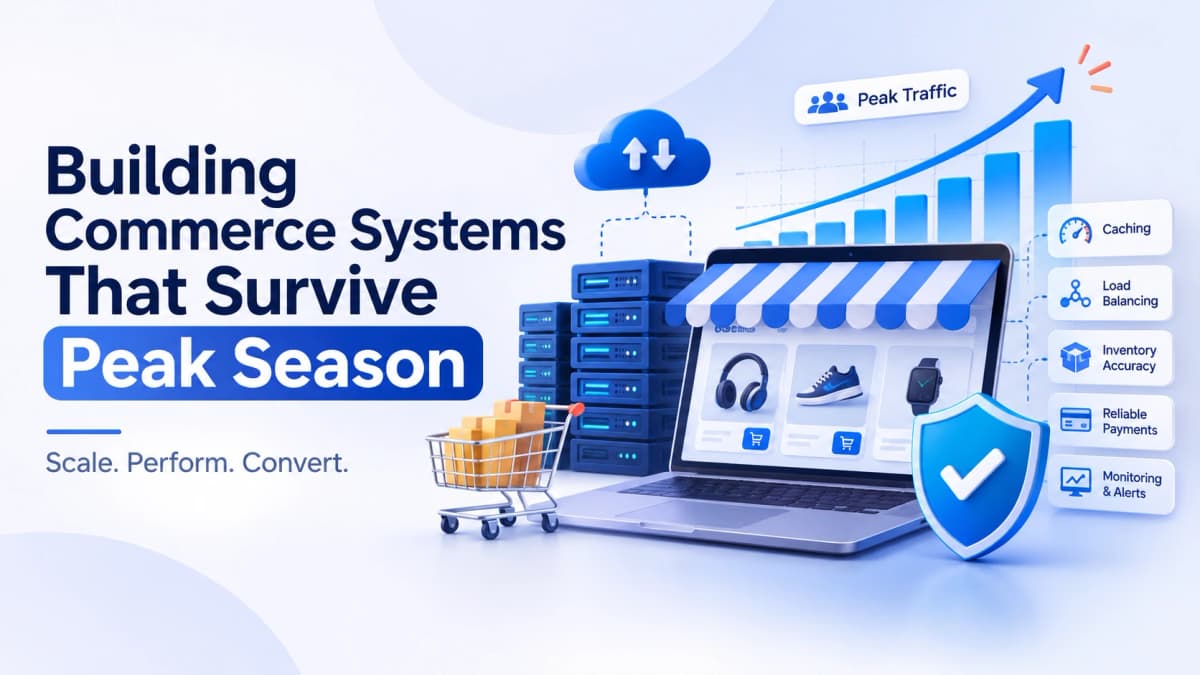
Every e-commerce business wants more traffic. Until that traffic arrives all at once.
A major campaign goes live, visitors flood the storefront, and within minutes, product pages become sluggish, checkout requests start timing out, and customers abandon their carts. Marketing delivered the traffic. The platform failed to convert it.
Black Friday, Cyber Monday, Christmas, Ramadan sales, and back-to-school campaigns can generate some of the highest revenue opportunities of the year. But they also expose weaknesses that remain hidden during normal operating conditions.
The problem is rarely traffic alone. It is how your platform handles that traffic across databases, application servers, payment integrations, inventory systems, and external services.
Building an e-commerce platform that survives peak season requires more than adding server capacity. It requires an architecture designed to handle sudden demand, protect critical operations, and recover gracefully when individual components become overloaded.
This guide explores the most common causes of peak-season failures and the engineering practices that help build reliable, scalable e-commerce systems.
Why Peak Season Breaks E-commerce Platforms
Under normal conditions, an application can perform reasonably well despite inefficient queries, tightly coupled services, or poorly managed resources. A sudden traffic spike changes that equation.
As concurrent users increase, small performance problems become system-wide bottlenecks. Four areas are particularly vulnerable.
Database performance: Product pages, cart operations, stock checks, and order processing generate database activity. Missing indexes, inefficient queries, and connection pool exhaustion can quickly turn the database into a bottleneck.
Checkout and payment processing: Checkout combines several operations, including price calculation, inventory reservation, payment authorization, and order creation. A failure anywhere in this chain can interrupt the entire purchase.
Third-party dependencies: Payment gateways, shipping providers, notification services, and external APIs operate independently of your infrastructure. Their latency, availability, and rate limits can affect your application's response times.
Inventory consistency: Concurrent purchases and delayed stock synchronization can create inaccurate inventory levels, resulting in overselling, cancellations, and disappointed customers.
These problems have a direct commercial impact. Slower experiences and failed transactions reduce conversion opportunities, while outages can damage customer confidence long after the campaign ends.
We explore this relationship in more detail in How Backend Performance Impacts Business Revenue.
1. Identify Your Real Bottlenecks Before Scaling
When an application struggles under heavy traffic, the immediate reaction is often to add more servers.
Sometimes that is the right decision. Often, it is not.
Horizontal scaling increases application capacity, but it does not automatically remove bottlenecks elsewhere. If every application instance depends on the same overloaded database, adding more instances may simply increase database contention.
Before investing in additional infrastructure, understand where requests spend their time.
Start by examining:
Endpoint latency: Identify which routes have the highest response times, particularly product listings, search, cart operations, and checkout.
Database performance: Inspect slow queries, missing indexes, connection pool usage, and lock contention.
Resource utilization: Monitor CPU, memory, network throughput, and application worker saturation.
External dependencies: Measure the time spent waiting for payment gateways, shipping APIs, and other third-party services.
End-to-end request traces: Follow complete user journeys to identify where delays accumulate across multiple components.
Pay particular attention to p95 and p99 response times. Average latency can hide serious problems affecting a smaller but significant percentage of customers.
Our guides on Why Adding More Servers Doesn't Always Fix Performance and Why Your Web Application Is Slow and How to Find the Bottleneck explain how to approach performance diagnosis systematically.
The principle is simple: measure first, identify the constraint, and scale the component that actually needs it.
2. Cache Strategically to Reduce Infrastructure Load
During major campaigns, thousands of visitors often request the same information: homepage content, category listings, product details, and promotional pages.
Rebuilding these responses for every request wastes application and database resources.
Caching allows frequently requested data to be served from faster storage, reducing repeated computation and database access.
A well-designed caching strategy should cover several layers:
CDN and edge caching: Serve static assets and suitable public pages from locations closer to visitors.
Application caching: Store frequently accessed data, such as category information, product summaries, and configuration.
Database optimization: Use query caching where appropriate, alongside proper indexing and efficient data access patterns.
HTTP caching: Configure appropriate cache-control headers and validators to avoid unnecessary transfers.
However, caching must be designed around data ownership and freshness.
For example, a public product description can usually be cached safely for a defined period. A customer's shopping cart, personalized pricing, or available stock requires more careful handling.
Important considerations include:
Never share user-specific responses between customers through an incorrectly configured cache key.
Invalidate or refresh cached prices and product information when relevant changes occur.
Avoid relying on long-lived cached inventory values for purchase decisions.
Use short-lived caching where data freshness is important.
Define fallback behavior when the cache becomes unavailable.
A stale product description might be inconvenient. A stale price or stock quantity can create financial and operational problems.
For a deeper explanation, see Caching Explained: How to Make Applications Faster Without Buying Bigger Servers.
3. Keep Inventory Accurate Under Concurrent Purchases
Overselling is one of the most damaging problems an e-commerce platform can experience during peak season.
Imagine a product with one remaining unit. Two customers attempt to purchase it at almost exactly the same time.
If both requests read the available quantity before either updates it, both transactions may proceed. The result is two confirmed purchases for one physical item.
This is a concurrency problem, not simply a synchronization delay.
A reliable inventory system needs to protect stock updates at the database level.
Important practices include:
Atomic stock updates: Use conditional database operations or transactions to ensure that stock cannot be reduced below the permitted quantity.
Temporary reservations: Reserve available stock during checkout for a limited period, then release it if payment is unsuccessful or the reservation expires.
Transaction consistency: Ensure inventory changes and order state transitions follow clearly defined rules.
Event-driven synchronization: Propagate inventory changes to storefronts, warehouse systems, and connected sales channels.
Idempotent processing: Prevent duplicated events or payment callbacks from applying the same inventory operation multiple times.
It is also important to distinguish between available stock, reserved stock, and physically held stock.
A simplified inventory calculation might look like:
Available stock = Physical stock − Reserved stock
The actual model may include additional quantities, such as damaged items, safety stock, or stock allocated to specific channels.
In multi-vendor marketplaces, the challenge becomes more complex because multiple sellers may manage inventory independently while customers purchase through a shared storefront.
The system must maintain clear ownership, reliable stock updates, and consistent order processing across these boundaries.
Our guide to How to Build Real-Time Inventory Synchronization explores the architecture and implementation in more detail.
4. Protect Critical Operations From Non-Critical Failures
Not every component of an e-commerce platform has the same business importance.
If a recommendation engine becomes unavailable, customers should still be able to purchase products. If a review service experiences high latency, it should not prevent checkout from completing.
This is the idea behind fault isolation: a failure in one component should not unnecessarily spread to the rest of the system.
Several engineering patterns help achieve this.
Separate critical and non-critical operations
Identify the operations required to complete a purchase and protect them from optional functionality such as recommendations, analytics, and promotional widgets.
Use timeouts and circuit breakers
External services should never be allowed to hold application requests indefinitely.
Set reasonable timeouts and use circuit breakers to temporarily stop requests to dependencies that repeatedly fail. This prevents one unhealthy service from consuming resources across the entire application.
Move non-essential work into background queues
Operations such as confirmation emails, invoice generation, analytics updates, and non-critical notifications do not always need to run inside the checkout request.
A background processing system allows the customer-facing operation to finish without waiting for every secondary task.
Design for graceful degradation
When a non-essential component becomes unavailable, the platform should continue offering its core functionality.
For example, product recommendations may disappear temporarily, but browsing, cart management, and checkout should remain available.
These improvements do not necessarily require a complete microservices architecture.
A well-structured monolith with background workers, clear module boundaries, and isolated external integrations can provide excellent resilience.
Our article on Why Modern E-commerce Platforms Need Microservices Over Monoliths for Scaling explains when separating services becomes worthwhile.
5. Protect Your APIs Against Traffic Spikes and Abuse
Peak-season traffic is not always generated by genuine customers.
Scrapers, automated bots, aggressive integrations, and abusive clients can generate significant request volumes. Even legitimate users can unintentionally overload an endpoint through repeated requests or poorly implemented integrations.
API protection should therefore be part of the platform's scalability strategy.
Consider implementing:
Rate limiting: Restrict request frequency based on IP addresses, authenticated users, API keys, or other appropriate identifiers.
Input validation: Reject malformed or unexpected data before it reaches expensive application logic.
Request size limits: Prevent excessively large payloads from consuming unnecessary resources.
Authentication and authorization: Ensure users and integrations can only access permitted resources.
Abuse detection: Monitor unusual request patterns, repeated failures, and suspicious traffic.
Observability: Track API latency, error rates, request volume, and resource consumption.
Rate limits should be designed carefully. Applying the same restrictions to product browsing, payment processing, and administrative operations can create unnecessary friction.
Critical customer journeys need limits that protect infrastructure without blocking legitimate purchases.
Authentication alone is not sufficient. See Why Your API Needs More Than Authentication: Rate Limits, Validation and Observability.
6. Load Test Before the Campaign, Not During It
There is only one reliable way to understand how an application behaves under heavy demand: test it under controlled conditions.
A platform that performs well with a few hundred users does not automatically perform well with several thousand concurrent visitors.
Load testing helps identify capacity limits, performance degradation, and failure points before they affect real customers.
A meaningful pre-season testing strategy should include four elements.
1. Simulate realistic customer journeys
Do not simply send thousands of requests to the homepage.
Reproduce actual user behavior:
Browse categories and product pages.
Search and filter products.
Add items to shopping carts.
Update quantities and calculate totals.
Complete checkout and simulate payment responses.
This creates a more realistic workload across the components that matter.
2. Test beyond expected peak traffic
Use expected traffic as your baseline, then gradually increase the workload.
Testing at two to three times the expected peak can provide a useful safety margin, although the appropriate target depends on your traffic forecasts, architecture, budget, and risk tolerance.
3. Test failure scenarios
High traffic is only part of the problem. Your platform should also be tested when dependencies become unreliable.
Simulate scenarios such as:
A slow or unavailable payment gateway.
Database connection exhaustion.
Cache invalidation or cache unavailability.
Background queues falling behind.
Temporary failures in shipping or notification services.
The objective is not simply to confirm that everything works when healthy, but to understand how the system behaves when something fails.
4. Test early enough to make improvements
Run initial tests several weeks before the campaign. Analyze the results, fix bottlenecks, and repeat the tests to validate improvements.
A load test that identifies problems without leaving enough time to resolve them provides limited business value.
7. Prepare Infrastructure, Monitoring, and Recovery Procedures
Scalability is not just about handling more requests. It is also about maintaining control over the infrastructure while demand changes.
Whether your platform runs on cloud infrastructure or dedicated servers, preparation should cover deployment, monitoring, backups, and recovery.
Before peak season, verify that you have:
Infrastructure headroom: Enough CPU, memory, database capacity, and network throughput to handle expected demand.
Automated deployments: A predictable release process that minimizes manual intervention.
Rollback procedures: The ability to quickly restore a previously stable application version.
Verified backups: Backups that have actually been restored and tested, not simply scheduled.
Real-time monitoring: Dashboards covering request latency, error rates, database performance, server resources, and queue depth.
Actionable alerts: Notifications that help the engineering team identify and respond to incidents before they become widespread.
A response plan: Clear responsibilities and escalation procedures for critical failures.
A particularly useful practice is establishing a code freeze before the campaign.
Avoid deploying non-essential changes during the final one or two weeks before peak season. This reduces the risk of introducing unexpected bugs into an otherwise stable system.
Emergency fixes may still be necessary, but every change should follow a controlled deployment and rollback process.
Our Cloud and DevOps Infrastructure Services cover infrastructure automation, deployment workflows, and operational reliability. You can also explore Cloud vs Self-Hosted Infrastructure to understand the trade-offs between different hosting approaches.
A Practical Peak-Season Readiness Checklist
Use this checklist to evaluate whether your e-commerce platform is ready for its next major traffic spike.
Performance and scalability
[ ] Slowest endpoints identified, profiled, and optimized.
[ ] Database indexes and expensive queries reviewed.
[ ] Database connection pools configured appropriately.
[ ] Caching implemented for high-traffic public content.
[ ] Infrastructure capacity validated against expected demand.
Inventory and checkout
[ ] Stock updates protected against concurrent purchases.
[ ] Inventory reservations and expiration rules implemented.
[ ] Payment callbacks and critical operations are idempotent.
[ ] Checkout isolated from non-critical services.
[ ] External integrations have appropriate timeouts and failure handling.
Security and reliability
[ ] API rate limits and input validation configured.
[ ] Load tests completed with realistic user journeys.
[ ] Failure scenarios tested.
[ ] Monitoring dashboards and alerts configured.
[ ] Backup restoration and rollback procedures verified.
[ ] Incident response responsibilities defined.
Release preparation
[ ] Final performance improvements deployed and validated.
[ ] Non-essential deployments frozen before the campaign.
[ ] Engineering team available during critical campaign periods.
What This Looks Like in Practice
At Hamo Engineering, we work on commerce systems where reliability, inventory accuracy, and scalability are practical engineering requirements rather than theoretical concepts.
Our work on Dokkan, a multi-vendor marketplace, involves challenges that are particularly relevant to high-traffic commerce platforms: multiple independent sellers, shared customer-facing experiences, inventory synchronization, and checkout operations that need to remain reliable.
A marketplace introduces additional complexity because different sellers, products, and operational workflows must coexist within one platform.
The same engineering principles apply to a single online store, a growing retail business, or a large multi-vendor marketplace. The architecture should evolve according to actual business requirements, expected traffic, and operational complexity.
For a broader perspective, explore How to Design a Platform That Can Scale From 1,000 to 1 Million Users and What a Marketplace App Really Costs to Build.
Frequently Asked Questions
When should I start preparing my e-commerce platform for peak season?
Ideally, begin eight to twelve weeks before a major campaign. This provides enough time to audit the architecture, identify bottlenecks, implement improvements, run load tests, and validate the results before traffic increases.
Do I need microservices to survive Black Friday?
No. Many e-commerce platforms can handle significant traffic with a well-structured monolithic architecture, efficient database queries, caching, and background workers. Microservices become useful when specific components need independent scaling, deployment, or operational isolation. Architecture should solve actual problems rather than introduce unnecessary complexity.
What is the most common cause of peak-season outages?
There is no single universal cause. Database bottlenecks, application resource exhaustion, connection pool saturation, inefficient queries, and overloaded third-party dependencies are all common contributors. Monitoring and load testing are essential to identify the actual limiting factor in each system.
How can I prevent overselling during high-traffic campaigns?
Use atomic stock updates, concurrency-safe inventory operations, and temporary stock reservations during checkout. Ensure that payment events and inventory changes are processed idempotently, and synchronize inventory across connected sales channels.
Can I improve performance while a sale is already running?
Some improvements are possible, such as increasing available infrastructure capacity, adjusting cache policies, and temporarily disabling non-essential features. However, major architectural changes and database optimizations are much safer to implement and validate before the campaign.
Is cloud hosting enough to guarantee e-commerce scalability?
No. Cloud infrastructure makes it easier to provision resources and scale components, but it cannot automatically fix inefficient queries, poor application architecture, or incorrect inventory operations. Scalability depends on how the entire system is designed and operated.
Ready to Make Your E-commerce Platform Peak-Ready?
A successful campaign should bring more orders, not more incidents.
Preparing for peak season means identifying performance bottlenecks, protecting critical operations, maintaining accurate inventory, and ensuring your infrastructure can handle demand without compromising the customer experience.
At Hamo Engineering, we help businesses design, develop, and optimize commerce platforms with performance, reliability, and long-term scalability in mind.
If your next major campaign is approaching, we can help assess your current architecture, identify potential weaknesses, and implement the improvements needed before traffic arrives.
Explore our E-commerce Development Services, discover our approach to Performance Engineering at Hamo Engineering, or contact our team to discuss your platform.