AI can build an application in hours. But can it keep your business running for years?
Vibe coding is changing the way software gets built. With tools like Cursor, Lovable, Bolt, Replit and other AI-powered development platforms, almost anyone can describe an idea in natural language and generate a working application without traditional programming experience.
For entrepreneurs, startups and small businesses, this sounds like a revolution.
Instead of spending thousands of dollars hiring developers, you can generate a website, build a dashboard, connect a database and launch a product in a fraction of the usual time.
And sometimes, it works remarkably well.
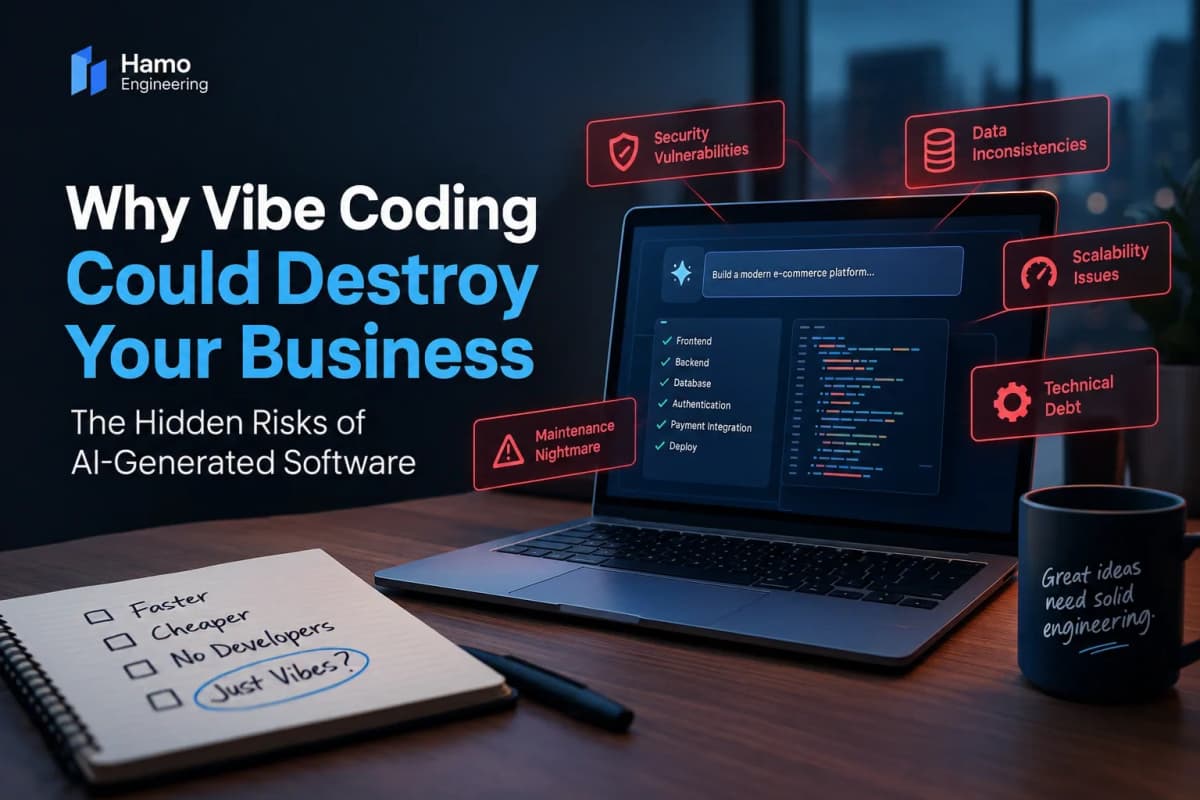
But there is a problem that many business owners overlook: building something that works today is not the same as building software that your business can depend on tomorrow.
A beautiful interface, a functional login page and a working checkout process do not necessarily mean that the underlying software is secure, maintainable, scalable or even architecturally sound.
The danger isn't that AI writes code. The danger is trusting generated code without understanding what is being built, how it works and what happens when things go wrong.
For a personal experiment, this might not matter.
For a business that handles customers, payments, orders, inventory, financial information or sensitive data, it can become an expensive mistake.
Let's explore why.
1. The illusion of instant software development
One of the biggest attractions of vibe coding is how quickly it produces visible results.
You describe an application, and within minutes, an AI tool generates:
A modern-looking dashboard.
User registration and authentication.
Database models.
Product listings and management.
Payment interfaces.
Administrative panels.
API integrations.
What previously required several development iterations can now appear in a single afternoon.
However, the speed of generating an interface should not be confused with the speed of engineering a complete software product.
A typical business application contains several layers that users rarely see:
Business logic and validation.
Database relationships and consistency.
Authentication and authorization.
API contracts and integrations.
Error handling and recovery mechanisms.
Security controls and data protection.
Performance optimization.
Deployment and infrastructure.
Logging, monitoring and maintenance.
An AI tool can generate code for all these layers. But generating code does not automatically mean that the resulting implementation is correct.
A checkout button might work perfectly during a demonstration while the underlying payment process remains vulnerable to duplicate transactions.
A dashboard might display inventory correctly while two simultaneous orders can still purchase the same last available item.
A login system might appear functional while permissions are incorrectly enforced on the backend.
The application looks finished. The engineering work may not be.
2. Security vulnerabilities you might never notice
Security is one of the most serious risks of relying blindly on AI-generated software.
A vulnerability doesn't necessarily produce an error or make an application look broken. In many cases, everything appears to work normally until someone discovers a way to exploit it.
AI-generated code can introduce familiar security problems, including:
Improper authentication and authorization.
Exposed API keys and sensitive credentials.
Insecure database queries.
Missing input validation.
Broken access control.
Insecure file uploads.
Weak session management.
Unprotected administrative endpoints.
Consider a simple example.
You build an online platform with an AI coding assistant. Customers can register, view their orders and manage their profiles.
Everything works.
But what happens if the backend only checks whether a user is authenticated, without verifying that the requested order actually belongs to that user?
A malicious customer might modify an API request and access another customer's information.
This is not a theoretical architectural concern. It is a well-known category of vulnerability called Broken Access Control.
The same problem can affect administrative dashboards, seller accounts, financial records and internal business information.
Security cannot be evaluated simply by asking whether the application works.
It requires deliberate threat analysis, server-side authorization, input validation, secure configuration, dependency management and ongoing testing.
For businesses handling customer information or transactions, these controls are essential.
3. Your application works until real users arrive
A common mistake in vibe-coded projects is testing an application under ideal conditions.
One user registers. One administrator creates a product. One customer places an order.
Everything works.
But real business environments are rarely that predictable.
Imagine an e-commerce business running a promotional campaign.
Within a few minutes, hundreds of customers visit the website. Several users attempt to purchase the same product simultaneously. Payment providers send delayed notifications. Some requests time out. Others are retried.
Now the system must handle:
Concurrent database operations.
Multiple simultaneous transactions.
Inventory consistency.
API rate limits.
Failed payment callbacks.
Duplicate requests.
Background processing.
Unexpected traffic spikes.
A system that works with five test users might fail under fifty concurrent users, depending on its architecture and workload.
The issue is not necessarily that AI-generated applications cannot scale. They absolutely can.
The issue is that scalability requires deliberate engineering decisions.
Database indexing, caching strategies, asynchronous processing, connection management, load testing and resource allocation all influence how an application behaves under pressure.
Adding more servers does not automatically solve these problems.
We explored this in more detail in our article about why adding more servers doesn't always solve performance problems.
A scalable application is not simply an application with more infrastructure. It is a system designed to handle growth without compromising reliability.
4. Technical debt accumulates faster than you think
Perhaps the most underestimated problem with vibe coding is technical debt.
When an AI assistant generates code, it generally focuses on satisfying the immediate request and the context available to it.
You ask it to add a feature. It modifies several files.
You discover an issue. You ask it to fix the issue.
Another feature breaks. You ask it to fix that too.
After several iterations, the application might contain:
Multiple implementations of the same functionality.
Repeated business logic.
Inconsistent naming conventions.
Unnecessary dependencies.
Poorly separated responsibilities.
Complex components handling too many tasks.
Database models that no longer reflect actual business requirements.
Workarounds that create new problems elsewhere.
Individually, these changes may seem harmless.
Together, they create a codebase that becomes increasingly difficult to understand and maintain.
This is especially problematic when the original AI-generated implementation is no longer fully understood by the person maintaining it.
Eventually, even simple changes become risky.
Adding a new payment method might break the checkout process. Updating an order workflow might affect inventory calculations. Changing a database structure might unexpectedly break several unrelated features.
The business then faces a difficult choice: continue adding patches or invest in restructuring the application.
And restructuring an established application can cost considerably more than designing it properly from the beginning.
5. AI doesn't automatically understand your business
Software development is not just about writing code.
It is about translating business requirements into reliable technical behavior.
Consider an e-commerce platform.
What happens when a customer cancels an order after payment?
Should the inventory be restored immediately?
What happens if a payment succeeds but the confirmation request fails?
Can a seller modify an order after it has entered the delivery process?
What happens when a customer requests a refund for only one item in a multi-product order?
These are business decisions with technical consequences.
An AI assistant can implement a workflow based on your instructions. However, if the requirements are incomplete, ambiguous or contradictory, the generated implementation may reflect those mistakes.
This becomes even more complicated in systems involving multiple users, sellers, administrators, delivery services, payment providers and external integrations.
A marketplace, for example, is not simply a website with product listings.
It needs reliable seller management, order orchestration, inventory synchronization, transaction handling, permissions and operational workflows.
We discussed some of these challenges in our article about building a scalable multi-vendor marketplace.
The important lesson is that business logic must be understood, documented and validated before it is translated into code.
6. Maintaining AI-generated software can become a nightmare
Launching an application is only the beginning of its lifecycle.
Software needs maintenance.
Dependencies receive security updates. External APIs change. Browsers evolve. Operating systems introduce new requirements. Business workflows become more complex.
Your application must evolve alongside these changes.
Now imagine that the original application was generated through hundreds of AI prompts, without proper documentation, architectural decisions or meaningful tests.
A new developer joins the project.
They need to understand:
Why certain architectural decisions were made.
How different modules communicate.
Which components depend on particular database structures.
How authentication and permissions work.
What happens when external services become unavailable.
Which parts of the application are safe to modify.
If none of this is documented, understanding the codebase becomes an investigation.
Even the original creator might struggle to explain why certain parts of the application work the way they do.
AI can help developers understand and modify existing code, but it cannot eliminate the need for clear architecture, documentation and ownership.
A business should never become dependent on a system that nobody can confidently maintain.
7. The hidden cost: Rebuilding what you thought you had saved money on
Vibe coding is often promoted as a way to reduce software development costs.
And in certain situations, it absolutely can.
However, the initial development cost is only one part of the total cost of ownership.
Imagine two businesses building similar applications.
Business A: The cheapest possible approach
The company uses AI tools to generate an application quickly. It launches with minimal testing, limited documentation and no clear architectural plan.
Initially, the savings look impressive.
Six months later, the business experiences security problems, unexpected bugs and difficulties introducing new features.
It eventually hires developers to investigate, restructure and sometimes rebuild significant parts of the application.
Business B: Engineering with AI assistance
The company also uses AI tools to accelerate development.
However, the project begins with requirements analysis, architecture planning and a clear technical direction.
The generated code is reviewed, tested and integrated into a maintainable structure.
Security, performance and deployment are considered from the beginning.
The initial investment might be higher, but the business has a stronger foundation for future development.
The difference is not whether AI was used.
The difference is whether engineering discipline was applied.
When evaluating software costs, businesses should consider the entire lifecycle: initial development, infrastructure, maintenance, security, improvements and future integrations.
Saving money during implementation means very little if the application becomes prohibitively expensive to maintain.
8. When vibe coding actually makes sense
Let's be clear: vibe coding is not inherently bad.
In fact, dismissing AI coding tools would be just as shortsighted as trusting them blindly.
These tools are incredibly useful when applied to the right problems.
Vibe coding can be an excellent choice for:
Prototypes and proof of concepts
Want to validate a startup idea before investing in a complete product? AI-assisted tools can help you build a functional prototype quickly.
Internal tools
Small dashboards, simple reporting interfaces and lightweight administrative utilities can often be built efficiently with AI assistance.
Experiments and MVPs
You can test user journeys, explore product ideas and validate demand before committing to a larger engineering investment.
Personal projects
For learning, experimentation and non-critical applications, vibe coding offers an accessible way to turn ideas into working software.
Early-stage product exploration
Founders can use AI tools to communicate ideas more clearly, demonstrate workflows and help engineering teams understand what they want to build.
The important distinction is understanding the consequences of failure.
If an experimental dashboard breaks, the impact might be minimal.
If your payment system processes transactions incorrectly, your business could face financial and reputational consequences.
Not every application requires enterprise-level architecture. But every application deserves an engineering approach appropriate to its risks.
9. The smarter alternative: AI-assisted software engineering
The future of software development is not a competition between human developers and AI.
It is about combining the speed of AI with the judgment and discipline of experienced engineers.
At Hamo Engineering, we see AI as a powerful engineering accelerator, not a replacement for engineering principles.
AI tools can help us:
Generate boilerplate code and repetitive components.
Explore alternative implementations.
Accelerate debugging and code analysis.
Improve documentation.
Assist with automated testing.
Speed up prototyping and development.
Explore integrations and technical solutions.
But the important decisions still require engineering judgment.
A reliable development process should include the following stages.
1. Understand the business before writing code
Define the actual problem, business objectives, users, workflows and functional requirements.
Do not start building an application simply because an AI tool can generate one.
2. Design the architecture
Choose appropriate technologies, define system boundaries, establish database structures and determine how different components communicate.
The architecture should reflect the actual needs of the product rather than follow whatever code an AI assistant happens to generate.
3. Implement with clear engineering standards
Use AI to accelerate implementation while maintaining consistent coding standards, modular responsibilities, appropriate validation and predictable application behavior.
4. Test beyond the happy path
Test more than the scenarios where everything works correctly.
Consider failed requests, invalid data, unauthorized access, simultaneous transactions, network interruptions and unexpected user behavior.
Automated tests, integration tests and security checks should be part of the development process.
5. Monitor the application in production
Launching software does not mean engineering is finished.
Logging, error tracking, performance monitoring, backups and infrastructure monitoring help identify problems before they become serious business disruptions.
6. Maintain and evolve the system
Keep dependencies updated, document important decisions, review security and continuously improve the application as business requirements change.
This approach allows businesses to benefit from AI's productivity without sacrificing software quality.
For a deeper look at how we approach this discipline, read our article about performance engineering at Hamo Engineering.
You can also explore why modern applications need more than basic authentication in our guide to API rate limits, validation and observability.
10. Before building your business on AI-generated code, ask these questions
If you are considering using vibe coding to create a business application, ask yourself a few important questions:
Do I understand how the application handles and protects customer data?
Are permissions enforced on the backend, not just hidden in the interface?
What happens when two users perform the same operation simultaneously?
Are payment transactions and external integrations handled safely?
Can another developer understand and maintain the codebase?
Is there a testing strategy beyond manually clicking through the application?
Are database backups, error monitoring and recovery procedures in place?
Can the architecture accommodate the next stage of business growth?
Do I have control over the source code, infrastructure, credentials and deployment process?
Who is responsible when something breaks in production?
If you cannot confidently answer these questions, it doesn't necessarily mean your application is bad.
It means there are important things you should investigate before depending on it.
Final thoughts: Building software is easy. Building software you can trust is different.
Vibe coding has fundamentally changed access to software development.
Ideas that previously required significant technical resources can now become working prototypes in a remarkably short time.
This is a positive development for entrepreneurs, startups and businesses of all sizes.
But we should not confuse accessibility with reliability.
An AI-generated application can look professional, work beautifully during a demonstration and still contain architectural, security or operational problems that only become visible when the business starts depending on it.
Your business doesn't need software that simply works today. It needs software that can keep working as your business grows.
Use AI to move faster. Use it to experiment. Use it to reduce repetitive development work.
But do not outsource your engineering judgment to a prompt.
At Hamo Engineering, we combine modern AI-assisted development with professional software engineering to build digital platforms, web and mobile applications, eCommerce systems and infrastructure designed for real business operations.
Whether you are starting from an idea, turning an AI-generated prototype into a production application or modernizing an existing system, the objective remains the same:
Build something that works, something you can maintain, and something your business can depend on.
Have an AI-generated application that needs a stronger engineering foundation?
Talk to Hamo Engineering about your project.