
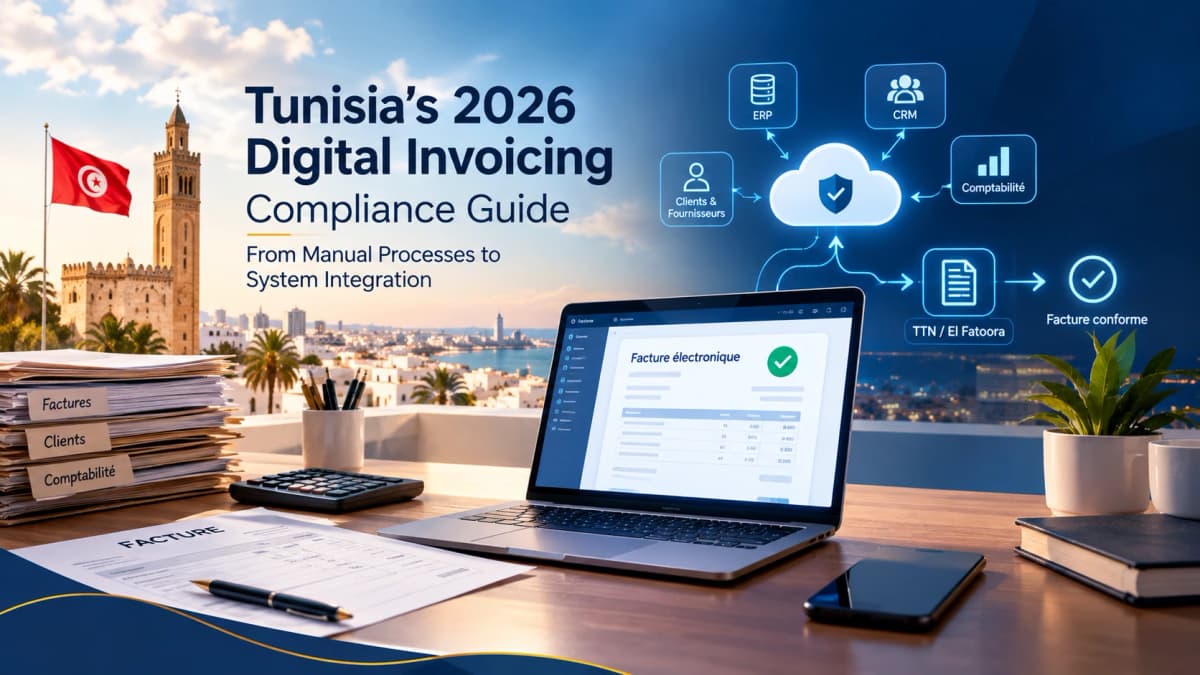
For many Tunisian businesses, invoicing has traditionally been a manual process. Companies create invoices using spreadsheets, accounting software, or PDF templates, send them to customers by email, and store copies for their accounting records.
This approach has worked for years. However, Tunisia's digital transformation is changing how businesses must manage their financial documents.
With the 2026 Finance Law expanding the scope of electronic invoicing, businesses need to pay closer attention to how invoices are created, authenticated, transmitted, and archived.
The transition is not simply about replacing paper invoices with digital documents. It involves adapting business processes, connecting software systems, and ensuring that financial information can move securely between companies and the national electronic invoicing infrastructure.
For business owners, the challenge is understanding what the regulations require, determining whether their activities are affected, and preparing their operations for a more connected invoicing environment.
In this guide, we explain Tunisia's electronic invoicing framework in 2026, the role of Tunisia TradeNet (TTN), the main compliance considerations, and how businesses can move from manual invoicing to integrated digital systems.
1. What Is Changing with Electronic Invoicing in Tunisia in 2026?
Electronic invoicing is not entirely new in Tunisia.
The country has been progressively introducing electronic invoicing requirements through its tax legislation and the national electronic invoicing infrastructure.
Before 2026, mandatory electronic invoicing primarily concerned specific categories of transactions, including:
Transactions with the State, local authorities, public establishments, and public enterprises by companies falling under the Large Enterprises Directorate (DGE).
Pharmaceutical sales between professionals, excluding retailers.
Petroleum product sales between professionals, excluding retailers.
The 2026 Finance Law introduced another important development.
Article 53 of the 2026 Finance Law
Law No. 2025-17 of December 12, 2025, introduced Article 53, expanding the scope of mandatory electronic invoicing to include service transactions.
This means that the reform is no longer limited to the previously covered transaction categories. It also addresses businesses and professionals providing services.
According to Common Note No. 02/2026 issued by the Tunisian tax administration, the extension covers service providers whose service activities are declared as either their primary or secondary business activity.
This can include different types of businesses and professionals, depending on their declared activities and applicable tax status.
However, there is an important distinction between the legal extension and its practical implementation.
The tax administration introduced transitional arrangements for service providers who have submitted their electronic invoicing membership applications but have not yet completed the required integration procedures.
As of October 2026, the proposed parliamentary amendment concerning the effective application of Article 53 had not been confirmed as published in the Official Gazette in the latest information available for this guide. Businesses should therefore verify the current legal position before relying on a proposed postponement.
The important takeaway: Electronic invoicing is an established part of Tunisia's tax framework, and businesses should prepare their systems rather than wait until the transition becomes urgent.
2. Who Needs to Prepare for Electronic Invoicing?
Not every business has exactly the same obligations.
The applicable requirements depend on the nature of the activity, the type of transaction, the company's tax status, and the relevant administrative procedures.
The 2026 expansion makes service providers an important group to consider.
Businesses providing services
Companies and professionals providing services should review their registered business activities and determine whether their operations fall within the expanded scope.
Examples include:
Software development and IT companies.
Consulting and professional services.
Marketing and advertising agencies.
Engineering and design studios.
Maintenance and technical service providers.
Transport and other service businesses.
Professional and non-commercial activities.
The list is illustrative rather than a definitive legal classification.
The key consideration is whether the service activity is declared in the business's official tax registration, either as its primary or secondary activity.
Companies already subject to electronic invoicing
Businesses already covered by the previous mandatory requirements must continue to respect their applicable obligations.
This includes relevant transactions involving public-sector entities and certain pharmaceutical and petroleum product sales between professionals.
The 2026 reform does not remove these existing requirements.
Businesses that sell physical products
Companies selling goods should also understand the distinction between selling products and providing services.
The expansion introduced by Article 53 specifically addresses service transactions. It does not mean that every ordinary sale of goods by every retailer automatically becomes subject to mandatory electronic invoicing.
Businesses operating across several activities should review each activity separately.
What about small businesses and independent professionals?
Business size alone is not enough to determine whether an entity is covered.
The nature of the declared activity, the applicable tax regime, and the administrative requirements all matter.
This is particularly important for independent professionals, small agencies, consultants, and service providers who may still issue invoices using simple templates.
Before making changes, businesses should consult their accountant or tax adviser to confirm their exact position.
3. Understanding El Fatoora and Tunisia TradeNet (TTN)
One of the most important parts of Tunisia's electronic invoicing system is Tunisia TradeNet, commonly known as TTN.
TTN operates the national electronic invoicing infrastructure through its El Fatoora service.
Instead of treating an invoice as an ordinary document that is simply emailed to a customer, the electronic invoicing framework introduces a structured process for generating, signing, transmitting, and registering invoices.
How does the process work?
At a simplified level, an electronic invoicing workflow involves several steps:
1. Invoice creation
The business creates an invoice using an invoicing application, accounting platform, ERP, or another compatible system.
2. Structured invoice generation
The invoice information is converted into the required electronic format, known as TEIF (Tunisian Electronic Invoice Format).
3. Electronic signature
The invoice is electronically signed using an appropriate qualified electronic certificate.
4. Transmission to TTN
The signed invoice is transmitted through the El Fatoora infrastructure using an approved connection method.
5. Registration and reference
The platform processes the invoice and provides the relevant registration information and unique reference.
6. Delivery and archiving
The registered invoice information is made available for the appropriate business and customer workflows, while the business maintains the required electronic records.
The exact implementation and technical requirements should be confirmed with TTN and the relevant authorities.
What is TEIF?
TEIF stands for Tunisian Electronic Invoice Format.
It is a structured format used to represent invoice information electronically.
Unlike an ordinary PDF document, which primarily presents information visually, a structured invoice contains organized data that software systems can process.
This distinction is important.
A PDF invoice sent by email is not automatically a compliant electronic invoice under Tunisia's regulated electronic invoicing framework.
The invoice must follow the applicable technical and legal requirements, including the prescribed format, electronic signature, and transmission procedures.
4. Why a PDF Invoice Is Not the Same as an Electronic Invoice
Many businesses believe they have already adopted digital invoicing because they generate invoices using Word, Excel, or PDF templates.
Although these tools reduce paper usage, they do not necessarily provide regulatory electronic invoicing compliance.
Consider two different situations.
Traditional digital document
A business creates an invoice in Excel, exports it to PDF, and emails it to a customer.
The document is digital, but it does not automatically satisfy the requirements of Tunisia's electronic invoicing framework.
Structured electronic invoice
A business creates an invoice through compatible software, generates the required TEIF document, applies the appropriate electronic signature, and transmits it through the authorized infrastructure.
This process is designed to provide the necessary authentication, integrity, traceability, and registration.
The distinction matters because digital documents and legally compliant electronic invoices are not interchangeable.
Businesses should avoid assuming that purchasing any invoicing application or creating PDF documents is sufficient.
5. What Information Should a Business Prepare?
A successful transition starts with reliable business and customer information.
Poorly maintained data can create errors, delays, and problems during invoice generation or transmission.
Before implementing an electronic invoicing solution, businesses should review the information they use in their current invoicing process.
Company information
Make sure your business information is accurate and consistent across your systems.
This includes:
Company legal name.
Tax identification number (matricule fiscal).
Registered address.
Relevant business activity information.
Applicable VAT information.
Authorized invoice signatories.
Customer information
Customer records should also be properly maintained.
Depending on the transaction and applicable requirements, this may include:
Customer legal name.
Tax identification number.
Billing address.
Customer identification details.
Contact information.
Invoice information
Your invoicing system should be able to manage:
Invoice numbers and numbering sequences.
Invoice issue dates.
Product or service descriptions.
Quantities and unit prices.
Amounts excluding tax.
Applicable VAT rates and amounts.
Other applicable taxes.
Total amounts payable.
Relevant references and supporting information.
These details should be validated before an invoice is transmitted.
The objective is to reduce errors at the source instead of correcting problems after invoices have already been issued.
6. How to Move from Manual Invoicing to an Integrated System
For many businesses, the most challenging part of electronic invoicing is not understanding the regulations.
It is changing the way their existing systems work.
A company might already have an accounting application, a CRM, an ERP, an inventory management platform, or a custom business application.
Replacing everything with a completely new system is not always necessary.
In many cases, the better approach is to integrate electronic invoicing into the existing business infrastructure.
Here is a practical transition strategy.
Step 1: Review Your Existing Invoicing Process
Start by understanding how invoices are currently created and managed.
Ask questions such as:
Where does invoice information come from?
Are invoices created manually?
Does the company already use accounting software?
Are customer records stored in a CRM?
Are invoices connected to orders or contracts?
How are issued invoices archived?
Who is responsible for reviewing and approving invoices?
This assessment helps identify the processes that need to change.
Step 2: Choose the Right Invoicing Software
The appropriate solution depends on the company's size, invoicing volume, business processes, and existing technology.
A small business with a limited number of invoices may benefit from a compatible invoicing application or portal-based workflow.
A company processing hundreds or thousands of invoices may need a more automated solution integrated with its accounting or ERP system.
The important requirement is that the chosen solution supports the applicable electronic invoicing procedures and can communicate with TTN.
Step 3: Obtain the Required Electronic Certificate
Electronic invoicing requires an appropriate electronic signature.
Businesses must arrange the qualified electronic certificate required for their invoicing process through an authorized certification provider.
The choice of certificate and signing arrangement depends on the company's organization, authorized signatories, and technical setup.
It is also important to plan certificate renewal, access management, and secure storage.
An electronic signature should be treated as a critical business credential, not simply another software setting.
Step 4: Complete the TTN Membership and Integration Procedures
Businesses need to follow the applicable El Fatoora enrollment process.
This includes preparing the required company information, submitting the membership application, and completing the technical requirements.
For businesses planning software integration, this stage may also involve coordinating with TTN regarding the available integration methods and testing environment.
Keep the relevant application receipts and membership documentation.
Step 5: Integrate Your Software
This is where businesses can move beyond manual invoicing.
Instead of creating every invoice separately and uploading it manually, the invoicing system can generate the required structured document using information already available in the company's software.
For example, a business application could:
Retrieve customer and transaction information.
Generate the invoice using approved business data.
Validate mandatory information.
Produce the TEIF representation.
Apply the appropriate electronic signature.
Transmit the invoice through the configured TTN connection.
Record the transmission result and registration reference.
Update the invoice status in the company's internal system.
Depending on the approved technical setup, communication with TTN may use methods such as web services or SFTP.
This creates a more consistent process and reduces repetitive manual work.
Step 6: Test Before Going Live
Before using the integrated system in production, test the complete workflow.
Important scenarios include:
Successful invoice transmission.
Missing customer information.
Incorrect tax calculations.
Invalid invoice data.
Duplicate invoice submissions.
Transmission failures.
Certificate expiration.
Rejected invoices.
Invoice status updates.
The system should also maintain a clear history of invoice creation, transmission, registration, and errors.
A successful integration is not simply one that sends data. It must also handle failures and provide enough information for staff to resolve problems.
7. Why Integration Is Better Than Managing Invoices Manually
For a small business issuing only a few invoices each month, manual processes may initially seem manageable.
However, as a business grows, manual invoicing introduces operational challenges.
Employees spend time entering the same information repeatedly, correcting mistakes, checking invoice statuses, and moving information between different applications.
An integrated invoicing system changes this approach.
Reduce repetitive administrative work
When invoice creation is connected to orders, projects, or accounting records, information can be reused instead of manually entered multiple times.
This reduces repetitive tasks and helps teams work more efficiently.
Improve data consistency
An integrated system can use centralized customer, product, and service information.
This helps avoid situations where different departments maintain conflicting customer records or invoice details.
Improve financial visibility
Management can access a clearer overview of issued invoices, pending transmissions, rejected documents, and other relevant financial information.
This makes it easier to identify operational issues.
Reduce processing errors
Automated validation can identify missing information, incorrect calculations, and inconsistent data before invoices are transmitted.
Automation does not eliminate every possible error, but it can significantly improve process consistency.
Prepare for business growth
A system designed around integration can support increasing invoice volumes without requiring the same increase in manual administrative work.
This becomes particularly valuable for businesses managing multiple departments, branches, projects, or customer accounts.
8. What About Businesses Using Custom Software, ERP or Accounting Platforms?
Not every company operates using the same software.
Some use commercial accounting applications. Others rely on ERP systems, custom-developed platforms, or a combination of several tools.
The good news is that electronic invoicing integration does not necessarily require replacing the entire technology stack.
A properly designed integration layer can connect existing business applications with the electronic invoicing infrastructure.
For example, a company using custom management software could add an invoicing integration module responsible for:
Retrieving invoice information.
Applying business validation rules.
Generating the required TEIF format.
Managing electronic signatures.
Communicating with TTN.
Tracking invoice statuses.
Handling transmission errors.
Maintaining audit records.
This approach allows the company to preserve its existing business workflows while introducing the required electronic invoicing capabilities.
Why API-driven architecture matters
Application Programming Interfaces (APIs) allow different software systems to communicate.
For electronic invoicing, APIs and integration services can connect invoicing software with customer management, order management, accounting, and other business applications.
A well-designed architecture can also centralize important functions such as authentication, data validation, error handling, and logging.
For companies planning long-term digital transformation, this flexibility is particularly valuable.
Rather than building isolated software features for every department, businesses can create a connected digital infrastructure that supports their operations as they grow.
9. Common Mistakes Businesses Should Avoid
Moving to electronic invoicing requires more than installing new software.
Businesses should avoid several common mistakes.
Assuming that PDF invoices are compliant
A digital document is not automatically a compliant electronic invoice.
The required format, signature, transmission, and registration procedures matter.
Waiting until the last minute
Membership applications, certificate acquisition, software configuration, and integration testing can require coordination and preparation.
Starting early gives businesses more time to address technical or administrative problems.
Ignoring customer and company data quality
Incorrect tax identifiers, incomplete customer information, and inconsistent invoice records can create unnecessary complications.
Data quality should be addressed before automation begins.
Choosing software without checking its integration capabilities
Not every invoicing application supports the Tunisian electronic invoicing framework.
Businesses should verify support for the applicable TEIF format, electronic signature requirements, TTN connectivity, and ongoing maintenance.
Automating without error handling
A system that generates invoices but cannot track failed transmissions or rejected documents creates another operational problem.
Reliable integration requires status tracking, error reporting, and clear procedures for resolving issues.
Treating compliance as a one-time project
Tax regulations, technical specifications, and business processes can evolve.
Electronic invoicing systems should be maintained and updated rather than treated as software that never needs attention after installation.
10. The Role of Digital Transformation in Tunisia's Business Environment
Electronic invoicing is part of a broader transformation in how businesses manage information and interact with public and private organizations.
Companies are increasingly expected to operate with better data management, connected software systems, and more reliable digital processes.
This creates opportunities beyond tax compliance.
A business that modernizes its invoicing infrastructure can also improve its accounting workflows, customer management, order processing, financial reporting, and operational visibility.
For example, connecting invoicing with inventory management allows product sales and financial records to remain synchronized.
Connecting invoicing with project management can help service companies generate invoices based on completed work or approved milestones.
Connecting invoicing with CRM software can provide better visibility into customer transactions and payment history.
These integrations transform invoicing from an isolated administrative task into part of a connected business operation.
The result is not simply a digital invoice. It is a more organized and efficient business.
11. Building Connected Business Systems with Hamo Engineering
At Hamo Engineering, we believe digital transformation should solve real operational problems.
For businesses moving towards electronic invoicing, the challenge is often not just obtaining an invoicing application. It is making sure that the new process works with the software and systems already running the business.
We help companies design and develop custom digital solutions that connect business operations, automate repetitive workflows, and support long-term growth.
Depending on the requirements, this can include:
Custom invoicing and management applications.
ERP and CRM integrations.
API development and system connectivity.
Business process automation.
Data validation and reporting systems.
Legacy software modernization.
Secure and scalable backend infrastructure.
For businesses that already rely on custom software, we can help extend existing applications rather than unnecessarily replacing them.
For companies still managing operations through spreadsheets and disconnected tools, we can help design a more organized digital workflow.
Our approach focuses on building software around how businesses actually operate.
Explore our custom web application development services or learn more about modernizing existing business systems.
Conclusion: Move Beyond Manual Invoicing and Build a More Connected Business
Tunisia's electronic invoicing framework represents an important step in the country's digital transformation.
The expansion introduced by the 2026 Finance Law makes it particularly important for service providers and businesses to understand their obligations, review their invoicing processes, and prepare their software infrastructure.
But businesses should look beyond regulatory compliance.
Moving from manual invoicing to an integrated digital system can improve data accuracy, reduce repetitive administrative work, strengthen financial visibility, and create better connections between business applications.
The most effective approach is to start with a clear understanding of the applicable requirements, establish reliable business data, choose compatible software, and integrate the invoicing process into the systems that already support daily operations.
At Hamo Engineering, we help businesses move from disconnected manual processes to modern, integrated digital systems.
Whether you need a custom business application, an existing system modernization project, or software integrations that connect your operations, the right engineering foundations can make your digital transformation more practical and sustainable.