
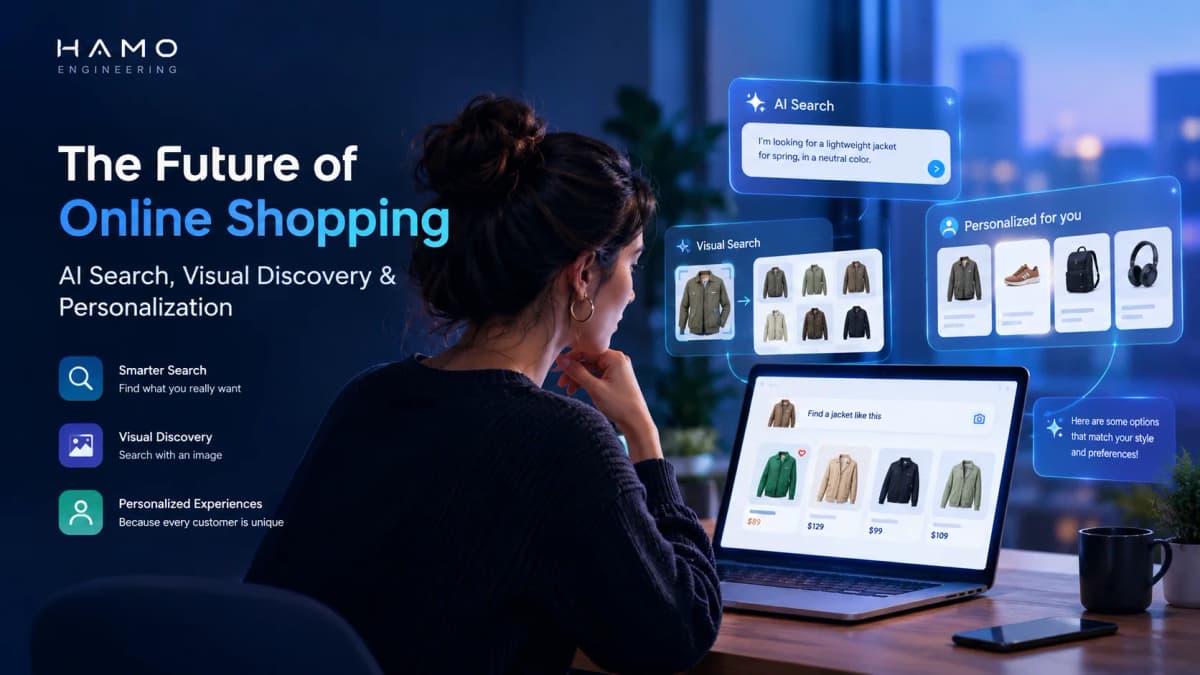
Online shopping has changed dramatically over the past decade. Customers no longer simply browse product categories, enter a few keywords into a search bar, and scroll through pages of results until they find something they like.
They expect more.
They want to describe what they are looking for in their own words, discover products through images, receive recommendations that match their preferences, and find answers without navigating through dozens of pages.
Artificial intelligence is making these experiences possible.
From intelligent product search and visual discovery to personalized recommendations and AI shopping assistants, the next generation of ecommerce platforms is moving beyond traditional online stores. Shopping is becoming more conversational, visual, and personalized.
For businesses, this shift represents an important opportunity: creating better shopping experiences, helping customers make decisions faster, and building stronger relationships with buyers.
Let's explore the technologies shaping the future of online shopping and what businesses should consider when preparing their ecommerce platforms for this new era.
1. AI-Powered Search: Moving Beyond Keywords
Traditional ecommerce search depends heavily on keywords.
A customer searching for a particular product must often know exactly what to type. If they use different terminology, make a spelling mistake, or describe a product in an unexpected way, the search engine may return irrelevant results or nothing at all.
This creates unnecessary friction.
Imagine someone visiting an online clothing store and searching for:
"I need something comfortable to wear during summer, preferably light-colored and suitable for everyday use."
A traditional search engine may struggle with this request because it expects specific product names or keywords.
An AI-powered search system approaches the problem differently.
Instead of simply matching words, it attempts to understand the meaning behind the customer's request.
It can interpret preferences, identify product characteristics, understand relationships between terms, and retrieve products that match the shopper's actual intention.
Understanding what customers really want
AI-powered semantic search helps ecommerce platforms interpret natural language rather than relying exclusively on exact keyword matches.
For example, customers could search for:
"A laptop for graphic design under my budget."
"A small sofa for a modern apartment."
"Running shoes for long-distance training."
"A gift for someone who loves photography."
The system can use product descriptions, attributes, categories, prices, and other available information to identify relevant results.
More advanced implementations can also support conversational search, allowing customers to refine their requests through follow-up questions.
Instead of restarting a search every time, shoppers can interact with the platform more naturally.
Why this matters for ecommerce businesses
Better search means customers spend less time looking for products and more time evaluating relevant options.
It can also help businesses expose products that would otherwise remain difficult to discover because of inconsistent naming, incomplete categorization, or differences between customer language and product descriptions.
For growing ecommerce businesses, search is no longer just a small feature inside the website. It is becoming a central part of the shopping experience.
2. Visual Search: Finding Products Through Images
Sometimes customers know exactly what they want, but they don't know how to describe it.
They might see a pair of shoes on social media, notice a particular piece of furniture in a friend's home, or find an interesting product while browsing the internet.
They want something similar, but finding it through traditional text search can be difficult.
Visual search solves this problem by allowing customers to use images instead of words.
A shopper uploads a photograph or selects an image, and the platform analyzes its visual characteristics to identify similar products in its catalog.
How visual product discovery works
AI-powered visual search can analyze characteristics such as:
Colors and patterns.
Product shapes and dimensions.
Clothing styles and designs.
Furniture materials and appearance.
Distinctive visual details.
For example, someone could upload a picture of a pair of sneakers.
Instead of manually searching through hundreds of products, the platform could display visually similar shoes available in its catalog.
The same concept works for clothing, furniture, accessories, electronics, home decoration, and many other product categories.
Visual discovery can also help customers find alternatives when an exact product is unavailable.
Turning inspiration into purchases
Visual search connects inspiration with product discovery.
Customers frequently discover products outside traditional ecommerce websites, including on social media, blogs, videos, and other digital platforms.
Allowing them to search using those images creates a more direct path from discovering something interesting to finding a product they can actually purchase.
For businesses, this introduces another way to make their catalogs accessible and useful.
It also highlights the importance of high-quality product photography, consistent product data, and properly organized catalogs.
AI can interpret images, but it still needs reliable product information to return useful results.
3. Personalized Shopping Experiences: Every Customer Is Different
Two customers can visit the same online store, search for the same product category, and have completely different expectations.
One might prioritize price.
Another might care more about quality, design, or specific product features.
A third might be looking for a particular brand or something that matches a previous purchase.
Traditional ecommerce platforms often display similar experiences to everyone.
AI makes it possible to adapt the shopping journey to individual customers.
How AI personalization works
AI-powered personalization can analyze relevant information such as:
Previous purchases.
Products viewed or saved.
Search queries.
Customer preferences.
Shopping patterns.
Interactions with product categories.
Using this information, an ecommerce platform can generate more relevant product recommendations and adapt what customers see.
For example:
A customer who frequently purchases sports equipment might see relevant accessories, new arrivals, or complementary products when visiting the store.
Someone browsing furniture might receive recommendations based on previously viewed styles, colors, or product categories.
The objective is not simply to display more products.
It is to help customers discover products that make sense for their needs.
Personalized recommendations that improve the shopping journey
Personalization can appear throughout the entire shopping experience:
On the homepage: Display relevant products and categories instead of presenting the same selection to every visitor.
On product pages: Recommend complementary products, alternatives, or similar items.
During checkout: Suggest relevant accessories or additions without unnecessarily complicating the purchase.
After a purchase: Help customers discover related products and return to the store for future purchases.
When implemented carefully, personalization can make an online store feel more useful and relevant.
However, businesses must also respect customer privacy. Personalization should rely on appropriate data collection, transparent practices, and suitable consent mechanisms.
4. AI Shopping Assistants: A More Natural Way to Shop
Traditional customer support often depends on predefined questions, menus, and scripted responses.
AI-powered shopping assistants introduce a different experience.
Instead of navigating multiple categories or searching through product descriptions, customers can ask questions in natural language and receive assistance based on the products available in the store.
Imagine a customer asking:
"I'm looking for a smartphone with a good camera, long battery life, and a reasonable price. What do you recommend?"
An intelligent shopping assistant could:
Understand the customer's requirements.
Search the available product catalog.
Compare relevant products.
Explain important differences.
Recommend suitable options.
Help the customer continue toward checkout.
This creates a more interactive shopping experience.
Beyond answering questions
The most useful shopping assistants do more than generate generic responses.
When connected to the actual ecommerce platform, they can access relevant product information, availability, pricing, and other approved data sources.
This allows them to provide answers grounded in the store's real catalog.
They can also support customer service by answering common questions about delivery, product specifications, returns, and order information, subject to the permissions and integrations available.
For ecommerce businesses, this can reduce repetitive support requests while making product discovery easier.
The important distinction is that an AI assistant should help customers make better decisions, not simply add another chatbot to the website.
5. Intelligent Product Recommendations and Predictive Shopping
Product recommendations have existed in ecommerce for years.
However, AI is making them more sophisticated.
Traditional recommendation systems often rely on relatively simple rules, such as displaying products from the same category or recommending items frequently purchased together.
Modern AI-powered recommendation engines can analyze more complex relationships between products, customer behavior, and shopping patterns.
Understanding relationships between products
Consider someone purchasing a digital camera.
A recommendation engine could identify relevant accessories such as:
Compatible lenses.
Memory cards.
Camera bags.
Tripods.
Additional batteries.
These recommendations are more useful than randomly displaying popular products.
AI can also identify patterns across different customers and product interactions to suggest items that shoppers may not have discovered independently.
Predicting customer needs
More advanced systems can use historical information and behavioral patterns to anticipate what customers might need next.
For example, an ecommerce platform could identify customers who regularly purchase certain products and provide relevant reminders or recommendations.
In inventory management, predictive analytics can also help businesses identify demand patterns and make better stock-planning decisions.
These capabilities connect the customer-facing shopping experience with the operational systems running behind the store.
That connection is particularly important for businesses managing large catalogs, multiple suppliers, or complex inventory operations.
6. The Rise of Multimodal Shopping: Combining Text, Images and Conversations
The next generation of ecommerce search will not depend on a single way of interacting with products.
Customers will increasingly expect to combine different forms of discovery.
They might upload an image, describe what they like, specify a budget, and ask an AI assistant to find matching products.
For example:
"Find a dining table similar to this picture, but in a lighter wood finish and under my budget."
This request combines visual recognition, natural language understanding, product filtering, and personalized discovery.
A traditional search engine would require several separate actions to achieve the same result.
A multimodal AI system can combine these interactions into one shopping journey.
What multimodal AI means for online stores
Multimodal systems can work with different types of information, including:
Text descriptions.
Product images.
Customer questions.
Product attributes.
Other supported media and contextual information.
By combining these capabilities, ecommerce platforms can offer more flexible ways to discover products.
This is particularly valuable for industries where appearance plays an important role in purchasing decisions, such as fashion, furniture, decoration, beauty, and consumer electronics.
The goal is to make product discovery feel natural rather than forcing customers to adapt to the limitations of a search interface.
7. What This Means for the Future of Ecommerce
These technologies are not isolated features. Their real value comes from how they work together.
Imagine a customer visiting an online marketplace.
They upload a picture of a product they like. Visual AI identifies similar items. The customer then describes additional preferences using natural language. Intelligent search filters the catalog, while personalization helps prioritize relevant options.
An AI shopping assistant answers questions about the products, and the customer completes the purchase through the platform's existing checkout process.
Behind the scenes, inventory, order management, payments, and delivery systems remain connected.
This is what a more intelligent ecommerce experience can look like.
The business benefits
When these capabilities are implemented around genuine customer needs, they can provide several advantages:
Better product discovery: Customers can find relevant products through different search methods.
Reduced shopping friction: Natural language and visual search remove unnecessary steps.
More relevant recommendations: Customers discover products that better match their interests.
Improved customer experience: Shopping becomes more interactive and easier to navigate.
Better operational insights: Businesses can understand product demand, customer behavior, and purchasing patterns.
More opportunities for sales: Relevant recommendations and easier discovery can help customers find products they might otherwise overlook.
However, AI does not automatically guarantee higher conversion rates or increased revenue. Results depend on product quality, implementation, customer needs, and the overall shopping experience.
8. What Ecommerce Businesses Should Do to Prepare
Businesses do not need to rebuild their entire online stores or implement every AI technology immediately.
A better approach is to establish the right foundations and introduce intelligent features where they provide measurable value.
Here are five important steps.
1. Organize Your Product Catalog
AI search and recommendations depend on accurate product information.
Product names, descriptions, categories, specifications, prices, images, and availability should be properly maintained.
A poorly organized catalog makes it harder for both customers and intelligent systems to understand what a store offers.
2. Invest in Better Product Data and Images
High-quality images are essential for visual discovery.
Businesses should maintain consistent product photography, multiple product angles where appropriate, and descriptive information about product characteristics.
This makes catalogs more useful for traditional search, visual recognition, and AI-powered discovery.
3. Improve the Existing Shopping Experience
AI cannot compensate for a confusing website.
Navigation, mobile responsiveness, product pages, checkout, and overall performance must work properly before advanced features are introduced.
A fast and reliable shopping experience remains essential.
4. Connect Your Business Systems
An intelligent ecommerce platform needs access to reliable information.
Product catalogs, inventory, pricing, customer accounts, orders, and other operational systems should communicate correctly.
This is where well-designed APIs and integrated commerce architectures become particularly valuable.
5. Introduce AI Gradually
Start with features that solve clear problems.
For example:
Improve search relevance.
Introduce product recommendations.
Add an AI-powered shopping assistant.
Experiment with visual product discovery.
Use predictive analytics to improve inventory planning.
Measure the results and expand the system as your business needs evolve.
The objective is not to implement AI simply because it is popular. It is to use technology to make your business more effective.
9. Building the Next Generation of Ecommerce Platforms
The evolution of online shopping requires more than adding an AI chatbot or installing a search plugin.
Modern ecommerce platforms must bring together several interconnected systems:
Customer-facing web and mobile experiences.
Product catalogs and inventory management.
Search and recommendation engines.
AI services and data processing.
Payment and order management.
Logistics and fulfillment integrations.
Analytics and operational monitoring.
All these components must work together reliably.
For businesses with growing catalogs, multiple sales channels, or complex operations, traditional platforms may eventually become restrictive.
This is why flexible architectures, API-driven systems, and headless commerce are becoming increasingly important.
By separating the customer-facing experience from the underlying commerce infrastructure, businesses gain more flexibility to introduce new interfaces, integrate AI services, and expand into additional digital channels.
You can explore our article on why we have moved towards headless architecture to understand how this approach supports more adaptable digital products.
At Hamo Engineering, we approach ecommerce as a connected business system rather than simply a website with a shopping cart.
We engineer custom ecommerce platforms, multi-vendor marketplaces, APIs, integrations, and AI-powered capabilities designed around real business requirements.
Our work on Dokkan, a Tunisian web and mobile marketplace, is an example of building a commerce ecosystem that connects product discovery, sellers, shopping experiences, and operational workflows.
For businesses planning to launch or modernize their own platforms, our ecommerce development services cover the engineering foundations needed to build and scale modern commerce experiences.
You can also read our guide on what businesses should know before building an ecommerce platform.
Conclusion: The Future of Shopping Is More Intelligent, Not More Complicated
The future of online shopping is not simply about putting more artificial intelligence into ecommerce websites.
It is about removing the barriers between customers and the products they want.
AI-powered search helps people express what they are looking for. Visual discovery makes it easier to find products through images. Personalization helps shoppers explore relevant options, while intelligent assistants make product research and decision-making more convenient.
Together, these technologies are changing how customers discover, evaluate, and purchase products.
For businesses, the opportunity is to build digital commerce experiences that are more useful, adaptable, and connected.
The companies that prepare their platforms with reliable product data, flexible architecture, and customer-focused technology will be better positioned to take advantage of these developments.
At Hamo Engineering, we build the digital platforms and intelligent systems that help businesses move towards that future.
Whether you are launching a new ecommerce business, modernizing an existing store, or planning an AI-powered marketplace, the right engineering foundations make all the difference.